
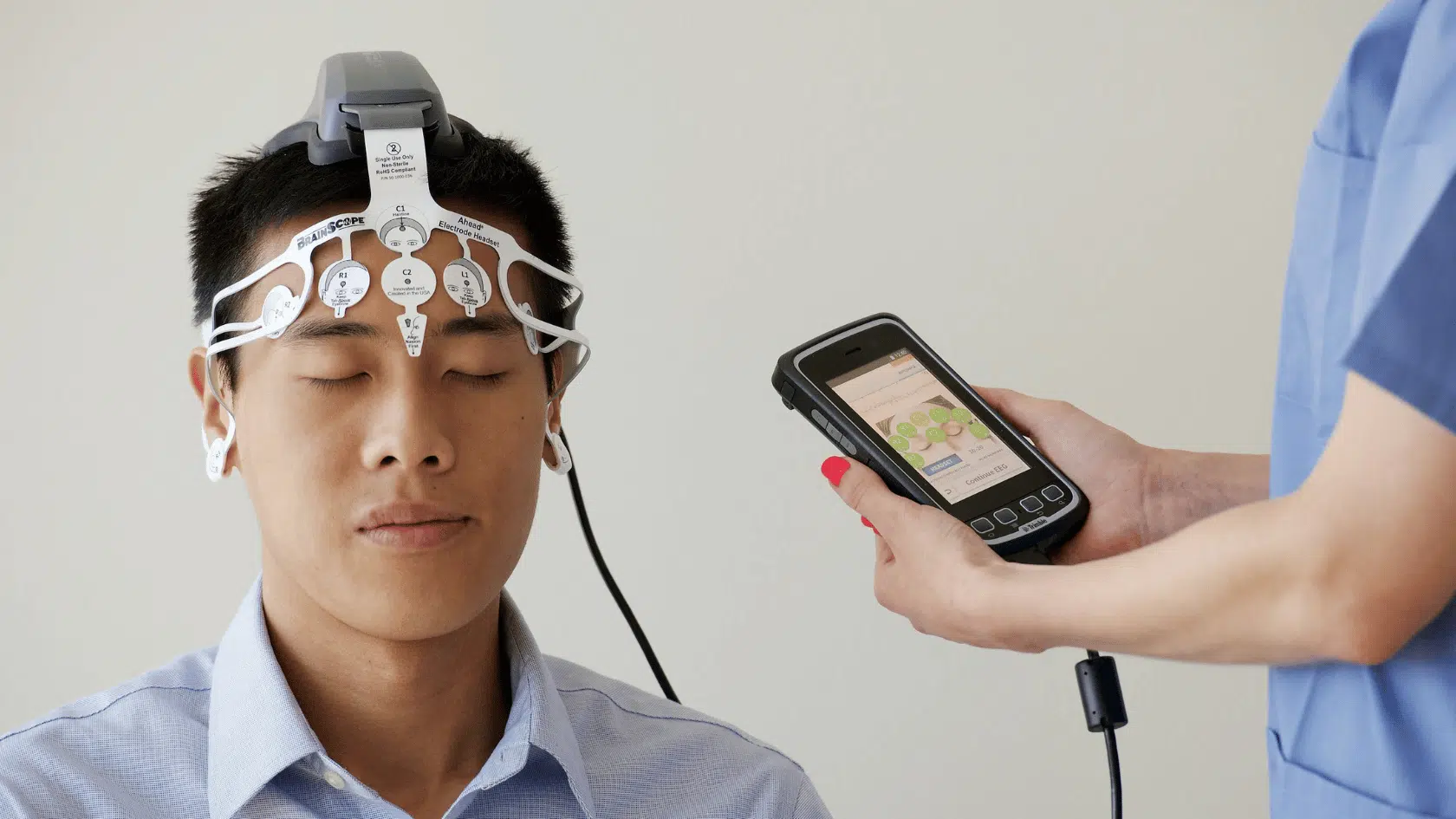
If a counselor has suggested Brainspotting therapy, or you saw it listed on a website and wondered what on earth it is, you’re in the right place. The name sounds clinical and a little strange, and most explanations online jump straight into words like subcortical and neurophysiological without ever telling you what actually happens in the room. So let’s do this the plain way. Here’s what Brainspotting is, what a session really looks like, how it’s different from EMDR, and how to tell whether it might be a fit for what you’re carrying.
The Short Answer

Brainspotting is a therapy approach that uses where your eyes are looking to help your brain access and release distress it hasn’t been able to process. Your counselor helps you find a specific eye position, called a brainspot, that connects to what you’re working on. Then you hold your gaze there and pay attention to what happens in your body while your counselor stays with you. You don’t have to narrate the whole story out loud. Much of the work happens quietly.
That’s it. No machines strapped to your head, no hypnosis, no losing control. You’re awake, aware, and in charge the entire time.
Where It Came From
Brainspotting was developed in 2003 by Dr. David Grand, a psychotherapist who was already working extensively with EMDR. During a session with a figure skater who kept freezing on a particular jump, he noticed her eyes locked and wobbled at one specific point as he moved his finger across her field of vision. He paused there instead of continuing the movement. She stayed on that spot, and a flood of material she had never accessed before began to surface and resolve.
That observation became the foundation of the method, summed up in a phrase you’ll hear often: where you look affects how you feel.
Most of us have noticed a small version of this without naming it. When you’re trying to recall something painful, your eyes drift to a particular place. When you’re overwhelmed, you look away or down. Your gaze and your internal state are connected more tightly than we tend to assume.
How Does Brainspotting Work?
Here’s the idea in everyday terms.
The thinking part of your brain, the part that reasons, explains, and puts things into sentences, is very good at insight. It’s how you can describe your childhood accurately, understand exactly why you react the way you do, and still react that way anyway. Plenty of people arrive at counseling having already figured out the why. Understanding didn’t change the response.
That’s because the reaction often lives somewhere else. Deeper, older parts of the brain handle threat, survival, and the automatic responses that fire before you’ve had a chance to think. That system doesn’t speak in sentences. It speaks in sensation, tension, heat, tightness in the chest, the urge to run. Which is why you can tell yourself I’m safe now and feel your body disagree.
Brainspotting is designed to work with that deeper layer directly rather than going through language first. By holding a particular eye position while noticing what’s happening in your body, you keep the relevant network active long enough for your brain to do something it’s naturally built to do: process and settle what got stuck.
Two things are happening at once during this. The first is focused activation and mindfulness: you stay gently connected to the difficult thing instead of avoiding it or being flooded by it. The second is the relationship in the room. Your counselor isn’t running a procedure on you. They’re tracking you closely, staying attuned, and adjusting as things move. Dr. Grand calls this dual attunement, and it’s a big part of why the method works when it works.
What to Expect in a Brainspotting Session
This is the part most people actually want to know, so here it is step by step.
You start with what’s bothering you. You and your counselor identify what you want to work on. It might be a specific memory, a recurring emotional reaction, a physical symptom, or just a vague heaviness you can’t name. You don’t need a tidy explanation.
You notice where you feel it. Your counselor will ask where that shows up in your body and how strong it is, often on a scale of one to ten. This gives you both a marker to track.
You find the brainspot. Your counselor slowly moves a pointer across your field of vision while you both watch for reflexive responses: a blink, a twitch, a yawn, a shift in breathing, a change in the feeling. Sometimes it’s the client who says right there, because the sensation sharpens or changes at one point. Other times it’s a spot where you feel unexpectedly grounded and resourced. Both are useful.
You stay with it. You hold your gaze on that spot and simply notice whatever comes: images, memories, emotions, body sensations, sometimes nothing in particular for a stretch. You don’t have to perform, analyze, or explain. Many sessions include long stretches of quiet. Some counselors use gentle bilateral music through headphones, which alternates softly between ears and helps many people settle.
Your counselor stays with you. They’ll check in periodically, help you stay in a workable range, and keep you from going further than your system can handle in one sitting.
You close down carefully. Sessions end with time to re-orient and settle before you walk back out into your day. A good Brainspotting session isn’t one that blows the lid off; it’s one that goes as far as your system can integrate.
Afterward, people commonly describe feeling tired, lighter, a bit tender, or unusually calm. Processing often continues quietly for a day or two, so it’s worth being gentle with your schedule right after.
Brainspotting vs. EMDR: What’s the Difference?
Since Brainspotting grew out of EMDR, the two share DNA. Both are brain-based approaches to trauma, both use the eyes, and both aim at material that talk therapy alone can struggle to reach. The differences are real, though.
Movement. EMDR generally uses ongoing bilateral stimulation, most often eye movement back and forth. Brainspotting typically holds one fixed eye position.
Structure. EMDR follows a defined eight-phase protocol with a fairly specific sequence. Brainspotting is more open-ended and follows wherever the client’s process goes, which some people find freeing and others find less predictable.
Talking. Both allow you to keep a lot inside, but Brainspotting tends to require even less verbal narration. For people who dread having to say certain things out loud, that can be the deciding factor.
Research base. This one matters, so we’ll be straight with you. EMDR has been studied for over thirty years and is recognized as an effective PTSD treatment by major clinical bodies. Brainspotting is newer, and the research is still catching up. Early studies are encouraging, including work comparing it directly with EMDR, but the number of large, rigorous trials is still small, and some researchers have raised fair questions about study design. Our honest position: it isn’t magic, it isn’t proven at EMDR’s level, and many of our clients have still found it profoundly helpful.
Neither approach is universally better. What fits you depends on your history, your nervous system, and your counselor’s read on what will help. If you want to go deeper on the other side of that comparison, we’ve written about the benefits of EMDR therapy for trauma recovery, and we offer EMDR trauma therapy as well.
What Brainspotting Can Help With
Brainspotting for trauma is the most common use, but it isn’t limited to trauma. Clients come to it for:
- PTSD and complex trauma, including things that happened long ago
- Anxiety, panic, and chronic tension that hasn’t responded to talk therapy
- Grief and loss
- Betrayal and relationship wounds
- Chronic pain and stress-related physical symptoms
- Performance blocks, whether athletic, academic, musical, or professional
- Anger and emotional reactions that feel bigger than the situation warrants
- Recovery from addiction, alongside other supports
It also tends to appeal to people who are highly verbal and analytically strong, the ones who can explain their patterns brilliantly and still feel stuck. When insight has already been exhausted, an approach that doesn’t run through explanation can open a different door.
Common Worries, Answered Honestly
“Is this hypnosis?” No. You’re fully conscious, you remember everything, and you can stop at any moment. Your counselor cannot make you do or say anything.
“Do I have to tell my counselor everything?” No. You can process material without narrating the details. Many clients find this is precisely what makes it bearable.
“What if nothing happens?” Sometimes not much happens in a given session, and that’s normal rather than a failure. It also isn’t the right fit for everyone, and a good counselor will say so rather than push.
“Is this some kind of spiritual practice?” It isn’t. Brainspotting is a clinical technique, not a belief system or a meditative tradition. Your faith, or lack of it, stays entirely yours.
A Word About Faith and Brain-Based Healing
Some believers feel a flicker of hesitation about approaches like this, and that’s an honest instinct worth taking seriously rather than brushing past. The question underneath it is usually: does needing this mean my faith isn’t enough?
Scripture says you were fearfully and wonderfully made. That includes the nervous system, the part of you that stores what you lived through and braces against it long after the danger has passed. Tending to how God built you isn’t a detour around spiritual healing. For many of our clients, it’s what finally makes room for it, because a body stuck in survival mode has very little capacity left for peace, worship, or trust.
We integrate faith when you want it, through prayer, Scripture, and honest conversation about where God has felt near or distant in your story. You can read more about our approach to Christian-based direction and about Christian trauma healing. If you’d rather keep faith out of the room entirely, that’s honored completely, and it will never be pushed on you.
Brainspotting at Redeemed Life Counseling in Argyle, TX
Brainspotting is one of the advanced approaches we offer from our Argyle office, alongside EMDR, neurofeedback, and experiential therapy. Our founder and executive director, Michelle Fitzhugh, LPC-S, is Brainspotting trained and specializes in complex trauma, PTSD, betrayal trauma, OCD, anxiety, and depression.
Brainspotting rarely works alone. Depending on what you’re facing, it may be woven into a broader plan that includes trauma therapy, Internal Family Systems, neurofeedback for focus and emotional regulation, or ongoing individual counseling to put words and new habits to what shifts. Your counselor will talk all of this through with you rather than handing you a protocol.
We’ve served Argyle and Denton County for more than twenty years, and we’ve been named Best of Denton County six years running. More to the point, we know what it costs to walk into a counseling office for the first time.
Ready to Find Out If It’s a Fit?

You don’t have to decide on Brainspotting before you call. You don’t have to know the right terminology, or have a diagnosis, or be certain that what you’re carrying is serious enough. The first conversation is simply about your story and what you’re hoping will be different.
When you’re ready, you can browse our counselors to find someone who feels like the right fit, look over our insurance information, or schedule your first session online. Questions are always welcome first: contact us or call (940) 222-8552.
Healing is possible, and you don’t have to figure out the path by yourself.
