
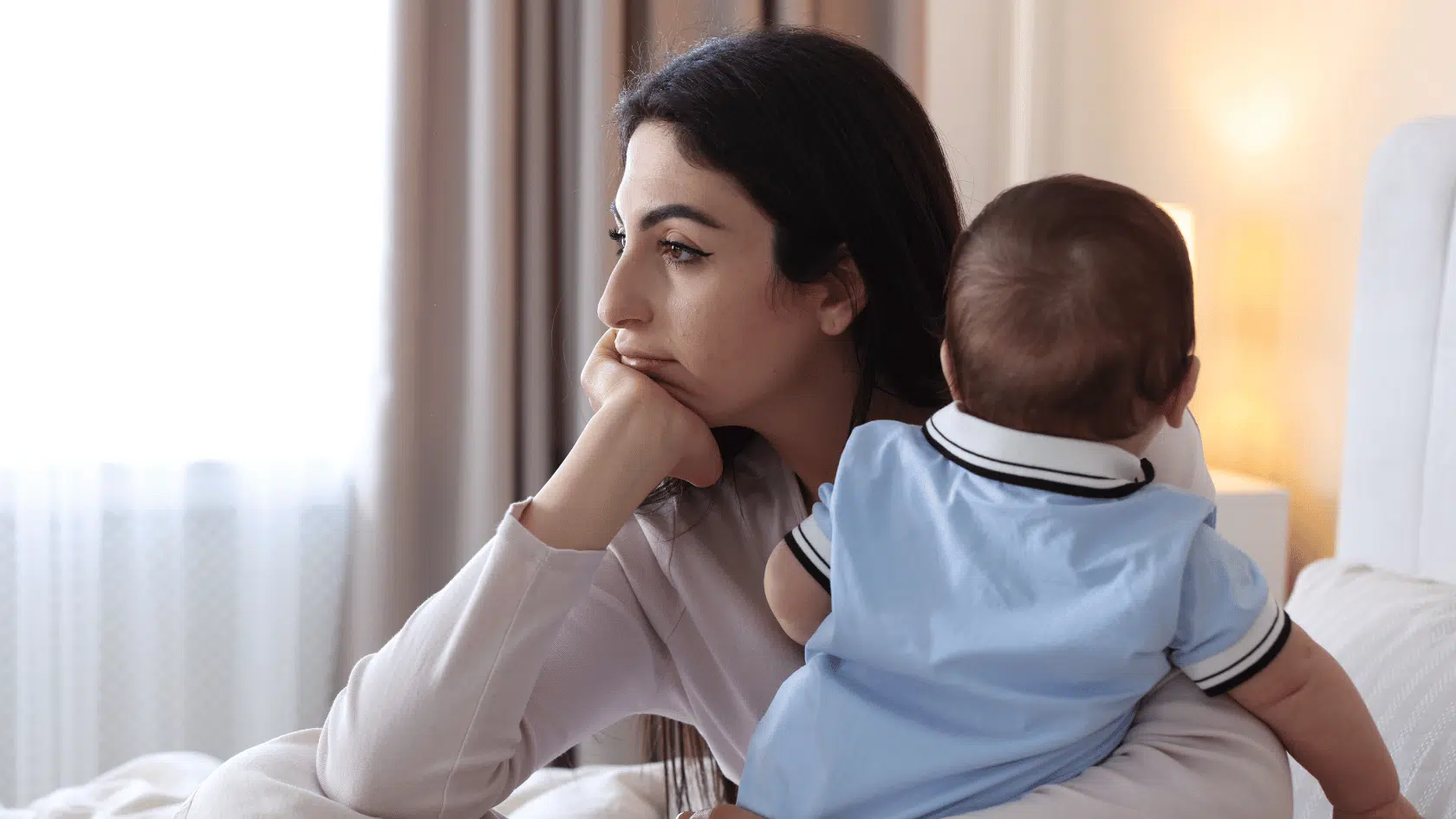
You’re probably reading this one-handed, at an hour when you should be sleeping, with a baby on you or finally down. Somewhere in the last few days a thought showed up that scared you, and now you’re searching postpartum depression vs. baby blues because you need to know whether what you’re feeling is normal or whether something is actually wrong.
Here’s the first thing to know: asking the question is not evidence that you’re a bad mother. It’s evidence that you’re paying attention. And the difference between baby blues and postpartum depression is real, knowable, and something you can start sorting out tonight.
The Short Answer

Baby blues affects most new mothers. It typically starts a couple of days after birth, peaks around day four or five, and lifts on its own within about two weeks. You cry easily, feel raw and overwhelmed, and swing between emotions but you can still feel moments of pleasure and connection.
Postpartum depression affects roughly one in seven or eight mothers. It can begin anytime in the first year, not just the first weeks. It lasts longer than two weeks, it doesn’t lift on its own, and it interferes with your ability to function, to enjoy anything, or to feel like yourself.
The single most useful question: is it getting better or is it staying? Baby blues improves. Postpartum depression digs in.
Baby Blues: What’s Normal
After birth, your hormones drop more sharply than at any other point in your life. Add sleep fragmented into ninety-minute pieces, a body recovering from something enormous, and total responsibility for a person who can’t tell you what’s wrong. Almost everyone feels unsteady.
Baby blues usually looks like:
- Crying without a clear reason, sometimes mid-sentence
- Feeling overwhelmed or unprepared
- Irritability, especially toward your partner
- Mood that shifts quickly, from joy to tears and back
- Trouble sleeping even when the baby sleeps
- Feeling more sensitive and thin-skinned than usual
How long do baby blues last? Typically under two weeks. If you’re past that mark and nothing has eased, that’s the clearest signal to pay attention to.
Postpartum Depression: What’s Different
Postpartum depression isn’t baby blues that lasts longer. It’s a different thing, and it isn’t caused by weakness, poor bonding, or insufficient gratitude.
Signs of postpartum depression include:
- Persistent sadness, emptiness, or numbness most of the day
- Loss of interest in everything, including the baby and things you used to love
- Deep guilt or a conviction that you’re failing, or that your baby deserves better
- Feeling disconnected from your baby, or going through the motions of care without feeling anything
- Trouble sleeping even when you have the chance, or sleeping far too much
- Appetite changes, in either direction
- Difficulty concentrating or making simple decisions
- Anger or rage that surprises you
- Withdrawing from people who want to help
- Thoughts of harming yourself, or that your family would be better off without you
A few distinctions worth holding onto. Baby blues usually still allows moments of genuine pleasure; postpartum depression tends to flatten everything. Baby blues makes you feel overwhelmed by the situation; postpartum depression turns the accusation inward, toward who you are. And baby blues comes with an end you can sense approaching, while postpartum depression makes the future look identical to right now.
Important timing note: postpartum depression can begin months after birth. Many mothers dismiss what they’re feeling at five or eight months because they assume the window has closed. It hasn’t.
Postpartum Anxiety: The One Nobody Warns You About
Not every postpartum struggle looks like sadness. Postpartum anxiety is extremely common and frequently missed, partly because a hypervigilant new mother looks like a diligent one.
It can look like a racing mind that won’t stop, a physical sense of dread, checking the baby’s breathing over and over, an inability to rest even when someone else has the baby, or a body that stays braced for a catastrophe that never comes.
About intrusive thoughts. Many new mothers experience sudden, unwanted, horrifying mental images of something terrible happening to the baby; dropping them on the stairs, something happening in the bath. These thoughts feel like evidence of monstrousness, so they go unspoken for months.
Here is what’s true: these thoughts are common, they are a recognized feature of postpartum anxiety and OCD, and the horror you feel about them is precisely what distinguishes them from something dangerous. They are not urges. They are not intentions. They are your brain’s threat system running far too hot around the most precious thing in your life.
Telling a counselor about them is safe and often produces enormous relief. Please don’t carry them alone for a year because you’re afraid of how they’ll sound.
When It’s an Emergency
Postpartum psychosis is rare, affecting roughly one or two mothers in a thousand, and it is a medical emergency requiring immediate care. It usually appears within the first two weeks. Warning signs include confusion, not knowing what’s real, hearing or seeing things others don’t, extreme agitation or a complete absence of need for sleep, paranoia, or thoughts about harming the baby that feel reasonable or compelling rather than horrifying.
If you or someone reading this recognizes that, don’t wait for an appointment. Go to an emergency room or call 911.
And if at any point you’re having thoughts of ending your life, please reach out right now:
- 988 — Suicide and Crisis Lifeline, call or text, 24/7
- 1-833-TLC-MAMA (1-833-852-6262) — the National Maternal Mental Health Hotline, free and confidential, call or text, 24/7, English and Spanish, staffed specifically for pregnant and postpartum mothers and their families
- Postpartum Support International — 1-800-944-4773
You are not the first mother to feel this, and it is treatable.
Why So Many Mothers Say Nothing
Most women who develop postpartum depression never tell anyone for weeks or months. The reasons are painfully consistent.
You’re supposed to be happy. Everyone keeps saying this is the best time of your life. Your mother did this with four children and no help. Admitting you’re struggling feels like admitting you weren’t cut out for the thing you wanted most.
And underneath all of it, for many women, sits a specific fear: if I say this out loud, will someone think I’m unfit?
That fear keeps mothers silent, and silence makes everything worse. What’s worth knowing is that perinatal mental health conditions are common, well understood, and treated as exactly what they are; a health condition that responds to care. Providers who work with new mothers see this every week. If the fear is what’s stopping you, you’re allowed to ask questions before you disclose anything: call the maternal hotline anonymously, or ask your OB or a counselor what the process looks like, before you decide what to share.
A Word for Christian Mothers
If you’re in a church community, there may be a second weight on top of the first.
You prayed for this baby. Maybe for years, maybe through loss. People at church still mention it. And now you feel numb or frightened or resentful, and the gap between how you’re supposed to feel and how you actually feel has become its own kind of shame. Perhaps someone quoted a verse about joy at you, and you nodded, and then cried in the car.
Scripture holds far more room for this than church culture sometimes does. A third of the Psalms are laments. Hannah wept so bitterly in the temple that the priest assumed she was drunk. Elijah asked God to end his life and was met with food, sleep, and gentleness rather than correction.
Postpartum depression is not a spiritual diagnosis. It’s a medical one, arising in a body that has just been through something enormous. Getting help for it is not a failure of faith any more than getting stitches would be. For many of the mothers we see, treatment is what finally makes room for prayer again, because numbness and terror leave very little space for anything else.
If you’d like faith integrated into your care, our counselors offer Christian-based direction. If you’d rather keep it out of the room, that’s entirely respected.
For Partners and Family Reading This
If you’re here because you’re worried about her, a few things help more than advice:
- Ask directly and without flinching: are you okay, really?
- Take something off her plate without being asked, especially a stretch of protected sleep
- Don’t argue with her guilt. It’s a symptom, not a conclusion that can be reasoned away
- Help her make the call, or make it with her
- Keep watching past the newborn weeks, since this can surface much later
Partners can develop postpartum depression too, and that gets discussed even less often than it does for mothers.
What Treatment Actually Looks Like
Postpartum depression treatment is not one thing, and it usually doesn’t take as long as women fear.
Counseling is the backbone for most mothers: a place to say the unsayable and work on the guilt, the identity shift, the loss of the life you had, and the expectations you’re measuring yourself against. Individual counseling with someone who understands this season is the most common starting point.
If the birth itself was frightening, an emergency, a NICU stay, a moment you thought you or your baby might not make it that can lodge in the body and keep the alarm running. Trauma therapy and EMDR are designed for exactly that kind of stuck memory.
New parenthood also puts pressure on a marriage at its least-resourced moment, and resentment builds fast when both people are depleted. Couples counseling helps more families through this season than people realize, and family counseling can help when older children and extended family are part of the picture.
Medication is a conversation for you and your physician or OB, including options compatible with breastfeeding. We coordinate with your medical providers and never make those decisions independently.
And practical support matters more than it sounds: protected sleep, food you didn’t have to make, and someone else holding the baby for two hours are treatment, not luxuries.
Counseling for New Moms in Argyle, TX

Redeemed Life Counseling has served Argyle, Denton, and the surrounding Denton County communities for more than twenty years, and we’ve been named Best of Denton County six years running. We offer in-person sessions from our Argyle office and online counseling across Texas, which matters more than usual when leaving the house with a newborn feels impossible.
You don’t need a diagnosis, a tidy explanation, or a good night’s sleep before you call. You just need to say that something doesn’t feel right.
Browse our counselors to find someone who feels like a fit, check our insurance information, or schedule your first session online. If you’d rather ask questions first, contact us or call (940) 222-8552.
You are not broken, you are not failing, and you will not feel like this forever. With help, mothers get well and you deserve the same care you’re giving that baby.
