
If you’re reading this, there’s a decent chance you’ve already tried everything. Trust-Based Relational Intervention, or TBRI, tends to find parents at the end of a long road: the sticker charts stopped working, the consequences only escalated things, and the parenting advice that worked beautifully for your friend’s kids seems to make yours worse. Maybe you’ve started to wonder whether something is wrong with your child, or with you.
Here’s the thing worth knowing before you read another word: if your child came to you through adoption, foster care, or kinship placement, or lived through something hard early on, ordinary parenting tools often don’t work, and that isn’t a failure of love or effort. It’s a mismatch between the tools and what your child’s nervous system actually needs. TBRI exists to close that gap.
The Short Answer
TBRI is an attachment-based, trauma-informed approach to caring for children whose early experiences shaped how they handle trust, connection, and stress. It was designed for what its founders called children from hard places, and it’s built on three sets of principles: Empowering (meeting physical needs), Connecting (meeting attachment needs), and Correcting (addressing behavior without breaking relationships).
The organizing idea underneath all of it is simple to say and hard to live: connection comes before correction, and behavior is communication rather than defiance.
Where TBRI Came From
TBRI was developed by Dr. Karyn Purvis and Dr. David Cross at the Institute of Child Development at Texas Christian University in Fort Worth, less than an hour from Argyle. It began with a summer camp for adopted and foster children who had experienced neglect, abuse, or trauma. The gains those children made surprised everyone involved, and the work grew from there into a model now used in more than sixty countries, in homes, schools, churches, courts, and residential programs.
Dr. Purvis spent her career saying something that still lands hard for a lot of parents: these children aren’t being difficult, they’re having difficulty. The behavior that looks like manipulation, defiance, or ingratitude is usually an old survival strategy still running long after the danger has passed.
Why Normal Parenting Tools Stop Working

Early adversity changes how a developing brain and body handle stress. A child who learned that adults were unpredictable, or that needs went unmet, builds a nervous system organized around staying safe rather than around trusting.
That shows up in ways that make no sense from the outside. A child hoards food in a house where there’s always dinner. A child melts down over a shirt tag or a change of plans. A child pushes away the parent who is most consistently kind, sometimes hardest right after a good day. A child lies about something they don’t even need to lie about.
Traditional discipline assumes a child who feels safe, can access reasoning in the moment, and is choosing a behavior. When a child is operating from fear, none of those assumptions hold. Consequences land as more threat, which produces more fear, which produces more behavior. Parents describe it as pouring gasoline on a fire and not understanding why.
TBRI starts somewhere else: with felt safety, meaning not whether your child is safe, but whether their body has registered that they are. Until that’s in place, very little else gets through.
The Three Principles of TBRI
Empowering: meet the body first
This is the least glamorous and often most immediately useful part of trauma-informed parenting. Bodies that are hungry, thirsty, under-slept, or sensory-overloaded cannot regulate emotions well, and children with early adversity are frequently poor at noticing or reporting these needs.
In practice this looks like water and protein-rich snacks at regular intervals rather than waiting for hunger, predictable routines, advance warning before transitions, and attention to sensory needs movement, pressure, quiet, light. Many parents are startled by how many “behavior problems” soften once blood sugar, hydration, and sleep are handled consistently.
Connecting: build the relationship that does the healing
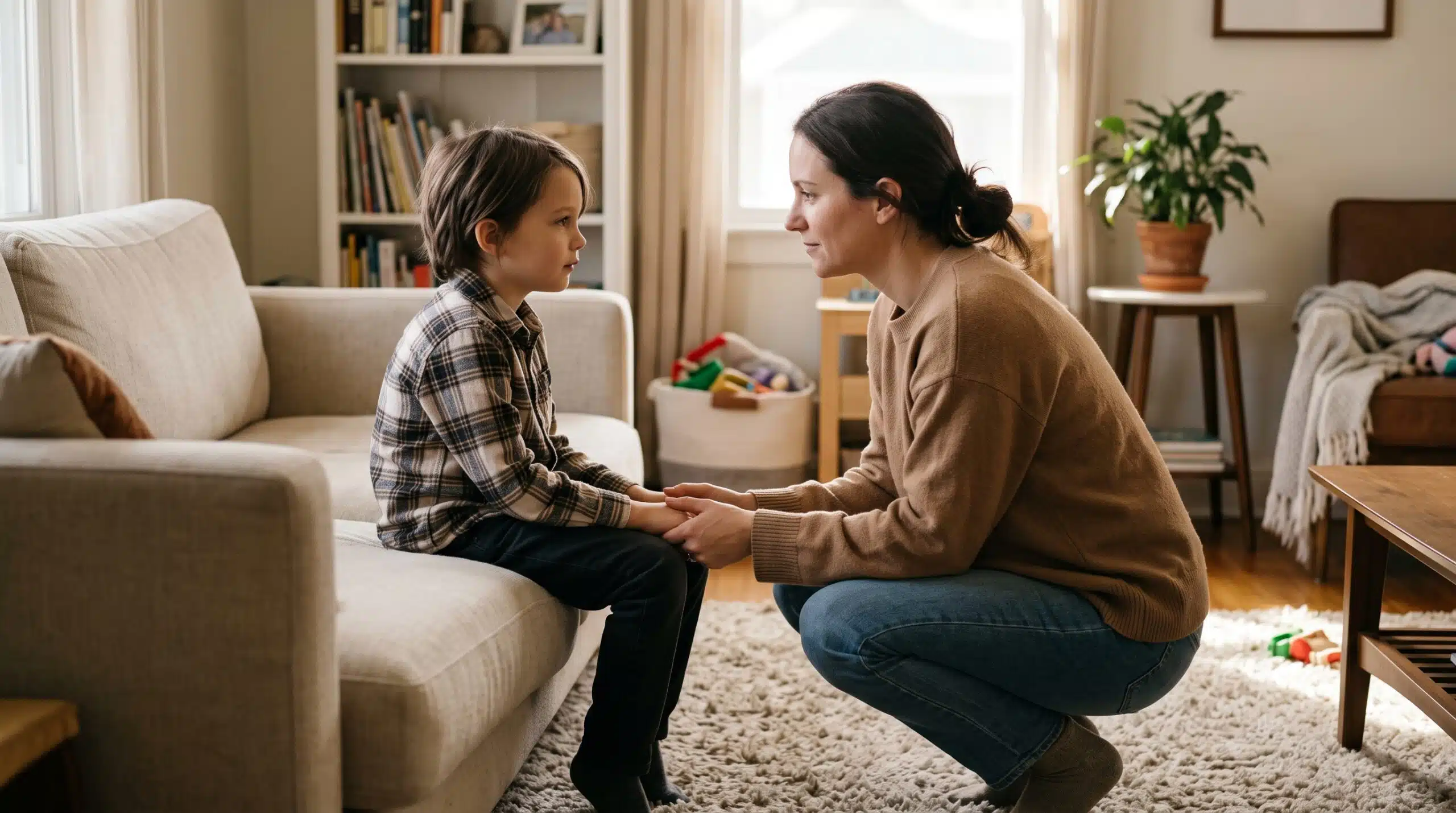
Connecting principles are about attachment, and this is where TBRI puts its weight. The tools are ordinary and the consistency is what matters: getting on your child’s eye level, playful engagement, naming feelings, matching their energy before asking them to match yours, and unhurried time together that has no agenda attached.
There’s a second half to connecting that catches many parents off guard. It asks you to look at your own attachment history and your own triggers, because a child in distress will find them. Understanding why your child’s screaming makes you want to leave the room, or why their rejection cuts the way it does, is part of the work rather than a distraction from it. That piece is a common reason parents seek their own individual counseling while doing this.
Correcting: address behavior without losing connection
This is where people misunderstand TBRI most often, so let’s be clear: it isn’t permissive. Behavior still gets addressed. Boundaries still exist. What changes is the goal and the method. You’re teaching skills rather than delivering punishment, and you’re staying in a relationship while you do it.
Correcting tools include offering a redo, where a child gets to try the interaction again the right way; giving choices within limits, so a child who has experienced powerlessness gets appropriate voice; and compromises when the request is reasonable. Responses are matched to the size of the behavior rather than the size of the parent’s frustration, and the correction happens after connection, not instead of it.
What This Looks Like on a Tuesday
TBRI parenting isn’t a program you run at a scheduled time. It’s a set of small shifts that compound.
A child comes off the bus dysregulated. Instead of asking about homework, you hand over a snack and sit near them for ten minutes without questions. A child snatches a toy from a sibling. Instead of a lecture, you say, “Let’s try that again with respect,” and let them practice asking. A child screams that they hate you. Instead of matching the volume, you stay steady and address it later, once the storm has passed and their brain is back online.
None of it is dramatic. Most of it is repetitive. That’s the point trust gets rebuilt through hundreds of small moments in which an adult stays regulated, stays present, and comes back.
What TBRI Is Not
It’s not a quick fix. Children who spent years learning that adults weren’t safe don’t unlearn it in a month.
It’s not permissive parenting. Structure and nurture are meant to be balanced. High nurture with no structure leaves a child feeling unsafe just as surely as the opposite.
It’s not only for adoptive families. TBRI began in adoption and foster care, and it’s used far more broadly now with children who’ve experienced medical trauma, a difficult birth, loss of a parent, divorce, violence, or chronic instability. Plenty of biological families find the principles helpful too.
It’s not a substitute for therapy when a child needs it. TBRI equips caregivers, which is enormously valuable, and some children also need direct clinical work.
What the Research Shows
TBRI is described as evidence-based, and there’s real support behind that: published studies have found reductions in behavioral problems and improvements in caregiver-child relationships across camps, residential settings, and foster and adoptive homes. It’s grounded in decades of established research on attachment, sensory processing, and neuroscience.
We’d also give you the fair caveat. Much of the TBRI-specific research has come from the institute that developed it, and independent, large-scale randomized trials are still limited compared with older interventions. The underlying principles that safety precedes learning, that regulation is built relationally, that early adversity shapes stress responses are on very solid ground. The specific packaged model is well supported and still accumulating evidence.
Faith, Adoption, and Grace for Tired Parents
A great deal of the foster and adoptive community in Denton County sits inside the church, and TBRI has traveled through those circles for good reason. Its language of seeing the whole child, of restoring what was broken through patient relationship rather than force, resonates deeply with how Scripture describes God’s own posture toward us.
There’s something else worth naming, though, because it goes unsaid in a lot of church conversations about adoption and fostering. You can answer a genuine call and still be exhausted by it. You can love your child fiercely and still feel resentment on a Wednesday afternoon. You can be doing everything right and still watch a child reject you for the hundredth time. None of that means you heard God wrong, and none of it means you’re failing.
If you’ve been carrying that privately because it felt too shameful to say out loud in your small group, please hear this: that’s one of the most common things we hear from parents in this exact situation. If you’d like faith woven into your own support, our counselors offer Christian-based direction, which integrates biblical truth with professional counseling rather than setting the two against each other.
Where Counseling Fits

TBRI is primarily a caregiver-equipping model, and families usually do best when the parenting approach and the clinical support point in the same direction.
At Redeemed Life Counseling, our work with families whose children have experienced early adversity runs along the same lines TBRI describes: safety first, connection as the engine of change, and behavior understood as communication rather than character. Depending on what your family needs, that may involve child and adolescent counseling for your child, family counseling to strengthen the relationships in the home, or trauma therapy using approaches like EMDR and Brainspotting when specific memories or reactions need direct attention. For children who struggle with regulation and focus, neurofeedback is sometimes explored as a complementary support.
And if the hardest part right now is you, the exhaustion, the guilt, the marriage strain that comes with parenting a child in distress that deserves care of its own. Individual counseling and couples counseling exist for exactly this, and needing them is not a verdict on your parenting.
Our counselors have served Argyle, Denton, and the surrounding Denton County communities for more than twenty years, and we’ve been named Best of Denton County six years running.
You Don’t Have to Figure This Out Alone
If your home has felt like a battlefield lately, the first step isn’t mastering a model. It’s telling someone what’s actually happening, without editing it to sound better than it is.
You can browse our counselors to find someone who works with children and families, check our insurance information, or schedule a first session whenever you’re ready. Questions are always welcome first contact us or call (940) 222-8552.
Your child’s story isn’t finished, and neither is yours. Healing happens in relationships, and you don’t have to build it by yourself.
